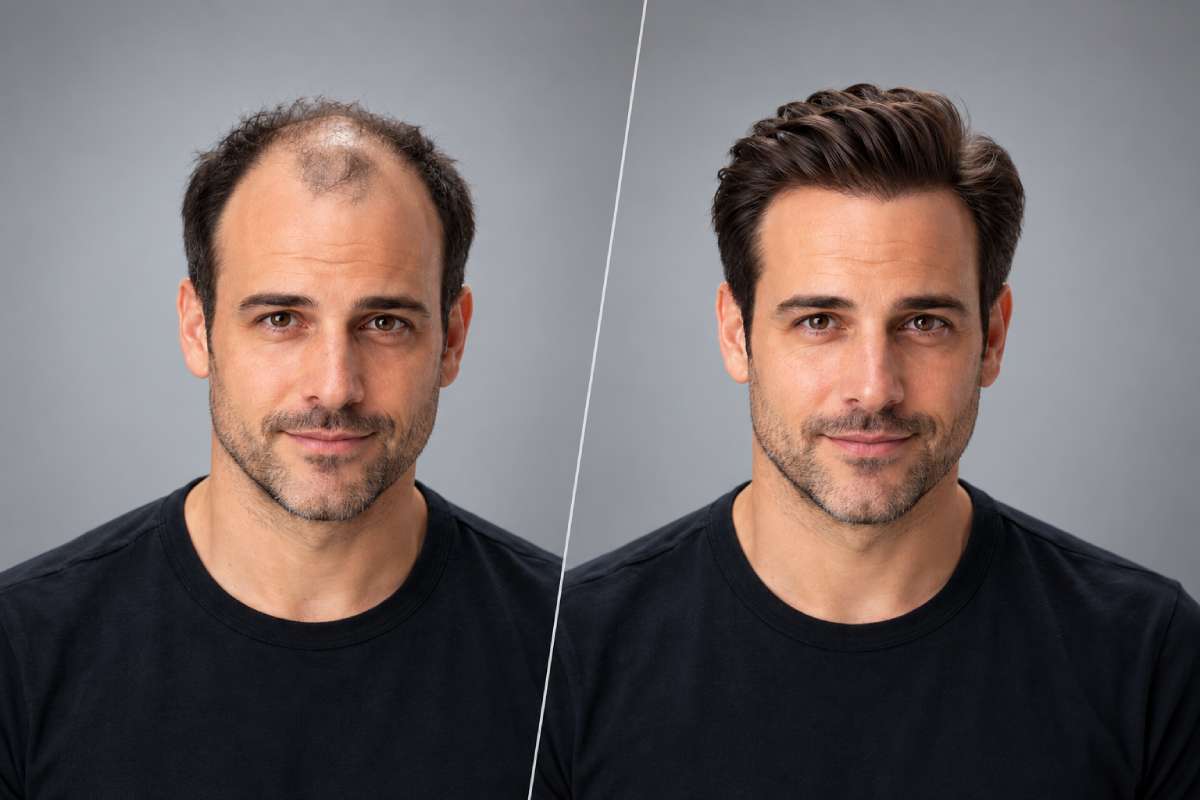
You look in the mirror and you can see it. The hairline is moving back. The crown is thinning. You’ve started wondering if a hair transplant might be the answer.
But then the doubts creep in. Am I old enough? Do I have enough donor hair? Is it too soon to do anything? Is it too late?
These are real questions. And the answers depend on a lot more than just your age.
Hair loss specialists will evaluate several factors before recommending a transplant. Understanding what they look for can help you walk into a consultation with realistic expectations and the right questions.
Key Takeaways
- Surgeons look at far more than age. Donor density, hair loss stability, scalp condition, and your hair’s characteristics all shape whether a transplant makes sense for you.
- Many patients who assume they are not ready are actually solid candidates. Others who feel ready may benefit from waiting a bit longer.
- A consultation with an experienced surgeon is the only way to know for sure, and there is no downside to getting one sooner rather than later.
It Goes Way Beyond Age
A lot of people think candidacy is mostly about age, but that is not all that your doctor is going to be looking at.
Age matters only because younger patients often have unpredictable hair loss. Someone in their early twenties may still be losing hair fast, so a transplant done too soon can look awkward as surrounding hair continues to fall out.
That said, there is no hard age limit. Surgeons routinely perform successful transplants on patients in their fifties, sixties, and beyond. What matters more is the full picture of your scalp, your health, and your goals.
What Hair Transplant Specialists Actually Look At
Here is what a thorough evaluation with a hair transplant specialist covers.
Your Donor Area
The donor area is the part of your scalp, usually the back and sides, where healthy follicles are harvested. These follicles are genetically resistant to hair loss, which is why they are used.
A surgeon will assess your donor density, which is how many follicular units, or small bundles of hair, exist per square centimeter. The natural range is about 80 to 100 follicular units per square centimeter. If yours is on the lower end, you may have fewer grafts available to work with.
The total surface area of your donor zone also matters. A larger zone with good density gives surgeons more to work with, especially if you need coverage across a wide balding area.
Hair quality is also taken into account. Coarser or curly hair provides better coverage than fine or straight hair, and a mix of thicker strands can make results look fuller with fewer grafts.
How Stable Your Hair Loss Is
Hair loss is a moving target. If yours is still advancing quickly, a transplant today could look very unnatural within a few years. The transplanted hair stays put, but the surrounding native hair keeps thinning, which can create an uneven look.
Surgeons use tools like the Norwood Scale to map where you are in the hair loss process and where you are likely heading. Understanding your trajectory helps a surgeon design a plan that still looks good as time passes.
If you are younger and losing hair fast, a surgeon may recommend starting on medication like Minoxidil or Finasteride first to slow the loss. For many men, they will actually regrow hair but the goal is to stabilize things before committing to surgery.
Your Hair’s Characteristics
Not all hair is equal when it comes to transplant results. The thickness, curl, and color of your hair all affect how much coverage a given number of grafts can provide.
Thick, wavy, or curly hair gives more visual coverage per strand. Fine, straight hair in a color that strongly contrasts with your skin tone can make thinning areas look more obvious.
This does not disqualify anyone. It just means your surgeon will factor these traits into planning how many grafts you need and where they should go and what the final results will realistically look.
Scalp Laxity
Scalp laxity is the looseness or flexibility of your scalp tissue. It is especially relevant for FUT (Follicular Unit Transplantation), a technique where the surgeon removes a thin strip of scalp from the donor area.
A more flexible scalp makes it easier to close the donor site neatly after the strip is removed. If your scalp is tighter, FUE (Follicular Unit Extraction) may be a better fit. With FUE, the surgeon removes individual follicles one at a time instead. You can learn more about the differences between FUE and FUT here.
Scalp laxity is assessed during the physical exam. A surgeon will gently move the scalp to evaluate how much give it has. This is not something you can self-assess from a photo or a questionnaire.
Your Overall Health
A hair transplant is a minor surgical procedure, but that still means your body needs to be in good enough shape to heal properly.
Surgeons will review your medical history to look for any conditions that affect clotting or healing, certain medications, and active scalp conditions like severe psoriasis or alopecia areata, which can all affect timing or your candidacy for transplant.
Smoking is also a real concern. It restricts blood flow and can slow graft survival. Many surgeons ask patients to stop smoking several weeks before and after surgery.
These are not automatic disqualifiers. They are things that need to be discussed so your surgeon can plan accordingly.
Your Expectations
Surgeons take expectations seriously. A technically successful transplant can still leave a patient disappointed if the result does not match what they had in mind.
The goal of a transplant is not to replicate your hair from age eighteen, it is to create the appearance of density and to frame your face well.
Patients who understand the supply-and-demand reality of transplantation tend to be more satisfied. You have a limited donor supply, so the goal is to use it wisely over time, not exhaust it all at once.
Curious whether a hair transplant is right for you?
Our doctors have been restoring hair in San Antonio since the 1990s. Get honest answers about your options in a consultation.
Schedule a ConsultationOr call (210) 496-9992
Hair Transplant Misconceptions Worth Clearing Up
“I should wait until I lose more hair.”
This one is common, and it is understandable. Waiting feels cautious, but waiting too long can mean fewer options. Once hair loss advances to a severe stage, there may not be enough donor hair to achieve meaningful coverage. Plus, preserving your hair earlier with medical therapy can make a big impact on your existing hair and alter the need for as much transplant later.
Getting a consultation early does not mean committing to surgery right now. It means getting information while your options are still wide open. A good surgeon will tell you honestly if it is better to wait.
“I don’t have enough donor hair.”
Many patients assume this before ever getting evaluated. The reality is that donor area assessment requires hands-on examination. Density and quality cannot be measured from a photo or a self-exam.
Even patients with lower donor density may still be solid candidates for a partial restoration, which can make a real visual difference. An experienced surgeon can give you an honest picture of what is achievable.
There are some very misleading photographs on social media that make it seems like a Norwood 7 became a Norwood 2 simply by traveling around the world and spending money on a very extensive hair transplant. This is not possible. The donor hair has to come from you and to replace the entire top of your head fully, you would need 20,000+ grafts, which is impossible with current technology.
A Quick Self-Assessment Checklist
No checklist replaces a real evaluation, but these questions can help you decide if you are ready to start the conversation.
- My hair loss has been mostly stable for at least one to two years
- I have at least a 2-inch-tall band of hair at the back and sides of my scalp
- I am in generally good health with no uncontrolled medical conditions
- I am not losing hair due to a medical condition that has not been addressed
- I have realistic expectations about what a transplant can and cannot do
- I am at least in my mid-twenties, or my surgeon has evaluated my loss pattern and cleared me
If most of these apply to you, you may already be a strong candidate. If several do not apply, a consultation can still help you understand what to work toward.
Find Out Where You Stand
The only way to know if you are a good candidate is to have a real conversation with an experienced surgeon. That means a physical exam, not just a photo review or an online quiz.
At Limmer Hair Transplant Center in San Antonio, we take time to assess every factor that affects your outcome. Our team brings decades of experience to every evaluation, so schedule your consultation today and walk away with a clear picture of your options.