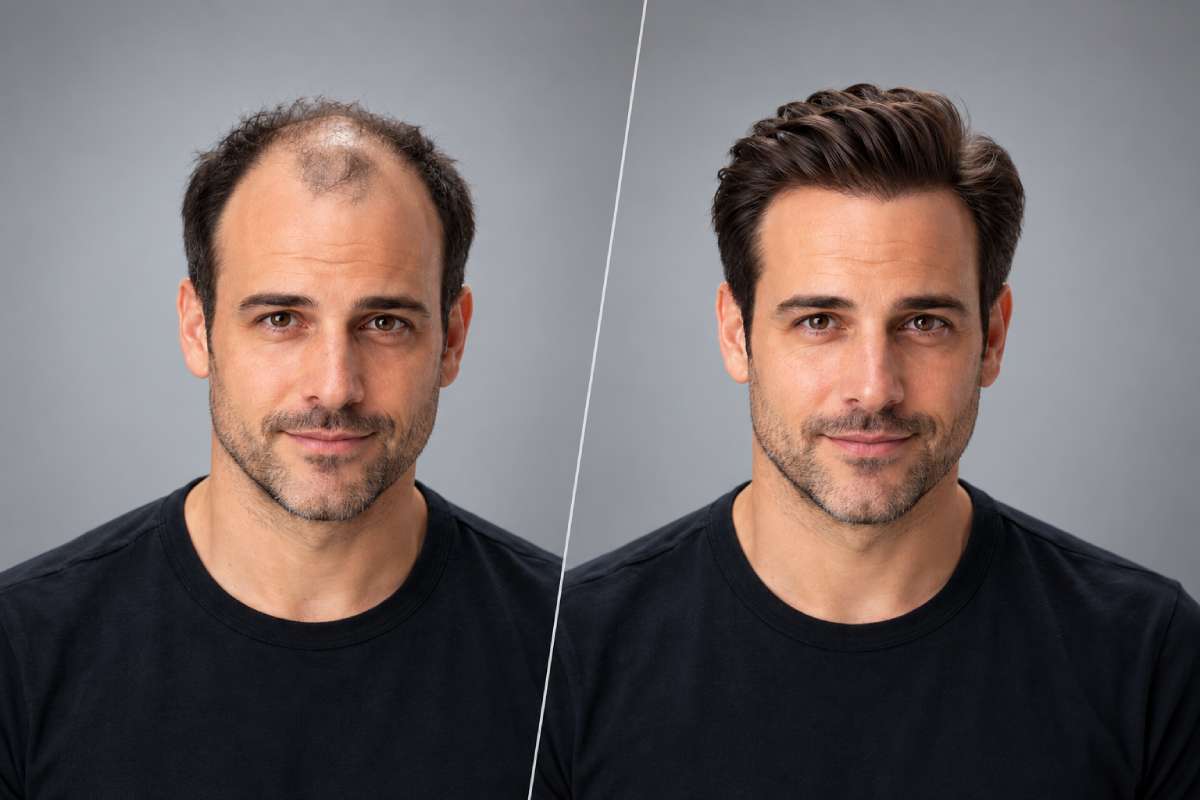
A poorly designed hairline can certainly give away a bad hair transplant; however, a discerning eye may also be drawn to irregularities in the back and sides of the head.
The back and sides of the scalp are termed the “donor area” because they are where the doctor “borrows” hair follicles to move them to thinning spots in other areas of the scalp. It’s important to understand that the donor area has a limited supply; once hair is removed from it, it does not grow back.
This is one of many reasons why hair transplant planning is not just about determining where to add hair on top of the head. It is also about protecting the donor area, so it does not look thin, patchy, or scarred later.
What is the Safe Donor Zone?
 The safe donor zone is the part of the back and sides of the scalp that is most likely to keep hair for life. This matters because transplanted hair is supposed to be long-lasting.
Our doctors focus harvesting inside this safe zone because hair outside of it can be less stable. Everyone loses hair as they age, so the hair that was growing strongly at 25 might not look as thick at 45. This progressive thinning can lead to issues both in the donor and in the transplanted areas. For instance, one may have perceptible bald/patchy spots in the donor if too many follicles were harvested from areas that continue to thin over time. Additionally, if the harvested grafts were not destined to remain thick for years to come, the transplanted area will also start to look thinner than desired.
Our doctors take the time to look at things like your current pattern of thinning, your age, and your family history. Then they choose donor boundaries with a built-in buffer to optimize results in both the donor and transplanted areas for many years.
What Overharvesting Looks Like and Why it Happens
Overharvesting means taking too many grafts from the donor area.
This is most often talked about with the FUE method of transplant, which stands for follicular unit extraction. In FUE, the doctor removes small groupings of hairs (called follicular units) one by one using a tiny punch tool. Each removal leaves a small dot scar in the scalp.
When done carefully, those dots are hard to notice, but if done too aggressively, the donor can start to look like it has missing patches.
Overharvesting can happen when:
- Too many grafts are removed too close together instead of spreading them out.
- The doctor removes too many grafts either in a single session or over multiple sessions.
- The plan ignores potential for future hair loss, so the donor thins with time.
- The patient already has thinning in the donor area that was not identified by the surgeon.
- Grafts are removed outside the safe donor zone
The goal when harvesting from the donor area is simple – move hair without making the donor look worse.
The Donor Area is Not Unlimited, so we Measure it
It’s extremely important that our surgeons carefully measure the donor area instead of assuming. Using a densitometer, our physicians count a patient’s follicular units and calculate their density in multiple areas throughout the donor area. This allows us to determine which sections of the donor area are good candidates for harvesting follicles and how many follicular units can likely be safely harvested over multiple sessions, if required.
Hair characteristics matter, too. Thick hair may hide extraction sites better than fine hair, dense hair covers more than sparse hair, and curly hair can cover more than straight hair. If there’s a large contrast between hair color and scalp color, that can make thinning easier to see as well.
Safe Excision Limits Help Prevent Patchy Donor Scars
The main way we aim to prevent FUE overharvesting is to keep extraction density reasonable both per session and over one’s lifetime.
A commonly used safety guide is to avoid very high excision density in one session. Many experts describe a safe single-pass range around 10 to 15 excisions per cm², especially when baseline density is around 65 to 75 follicular units per cm². In other words, keeping the density of extraction under 20-25% generally safeguards against noticeable thinning.
This guideline is helpful because it forces a more conservative plan. Instead of clearing out one area, the surgeon spreads the work out and leaves enough hair behind for coverage.
Some guidelines also describe coverage measures like Hair Diameter Index (HDI) or Hair Coverage Value (HCV). These concepts are a way to estimate how well the donor will still “cover” the scalp after harvesting. In plain language, it is another way of saying, “Will the donor still look full when we are done?” These individualized values can help surgeons pre-judge a patient’s effective scalp coverage based on hair characteristics including but not strictly limited to hair counts.
Not every patient can safely reach a standardized number of grafts. The doctor must recognize what will look natural long-term, not just what will produce the largest graft count.
How to Prevent the Patchy Look with FUE
Good FUE is not just removing grafts; it is removing them in a way that keeps the donor area even.
Spread Out Extractions
Instead of taking grafts in a straight line or in tight clusters, the surgeon spaces them out in a pattern that keeps coverage uniform. A zigzag or scattered approach can help prevent obvious gaps.
Respect the Safe Donor Zone Borders
Taking grafts too high or too low outside the safe donor zone can also cause trouble later. If hair loss creeps into those areas over time, the extraction dots can become more visible. Staying inside the safest area helps avoid that risk.
Curious whether a hair transplant is right for you?
Our doctors have been restoring hair in San Antonio since the 1990s. Get honest answers about your options in a consultation.
Schedule a ConsultationOr call (210) 496-9992
How to Reduce Donor Scar Visibility in FUT
FUE is not the only hair transplant method. FUT, or follicular unit transplantation, also known as the strip method, allows the doctor to remove a thin strip of scalp from the donor area; this strip is closed with stitches.
A linear scar like this can heal very well, but scar width can increase when the strip is too wide or when closure is done with too much tension. That is why conservative strip planning matters.
One technique used to help hide the FUT scar is called the trichophytic closure. In simple terms, the surgeon trims a tiny edge of skin during closure so hair can grow through the scar line as it heals. That hair growth can make the scar harder to see, especially when the hair is worn a bit longer.
Watch for Donor Thinning Patterns That Raise Risk
Whether considering FUT or FUE, some common types of thinning that reach into the donor area are:
- Advanced male patterned hair loss, where thinning affecting the crown dips low into the back of the scalp
- Retrograde alopecia, where hair loss creeps upward from the nape and lower sides
- Diffuse unpatterned alopecia (DUPA), where thinning involves nearly all of the scalp hair, including the donor area.
If these findings are present or are likely to be present in the future, harvesting has to be handled very carefully, or the donor can look depleted fast.
What if Someone Already Has Patchy Donor Scars?
If a donor area is already thin or has visible scarring, there are still options we can discuss:
- Wearing hair longer to cover thin spots
- Scalp micropigmentation (SMP), which is a tattoo-like treatment that adds the look of tiny hair dots
- Transplanting grafts into the donor area in select cases, if other donor sites exist, this is occasionally an option
Not every repair option fits every person, but the first step is always the same: figure out why the donor looks patchy, and plan a solution that does not make it worse.
What to Look for in a Hair Transplant Specialist who Protects the Donor Area
A careful hair transplant doctor should be able to explain their donor plan clearly.
During a consult, it is fair to ask:
- How do you define my safe donor zone?
- How do you measure donor density?
- How many grafts can be safely taken without overharvesting?
- How do you spread extractions in FUE to avoid the moth-eaten look?
- If FUT is being considered, how do you reduce the look of the linear scar?
If the plan feels like “more grafts no matter what,” that is a red flag. A good plan protects your future options.
Hair Restoration Experts in San Antonio
At Limmer Hair Transplant Center, donor planning is treated like a long-term strategy, not a one-day shopping spree. Protecting the safe donor zone and avoiding overharvesting is a big part of creating results that still look natural years down the road.
If you are thinking about a hair transplant and want a donor-focused plan that aims to prevent patchy donor scars, schedule a consultation with the Limmer HTC team.